Please Note:- +91 -8890090505 is the only contact number for shipindiasey.com We don't have any other website beware of fraudsters.
- EMAIL: info@shipindiasey.com
- Call Us Now: +91-8890090505


FCL & LCL Sea Freight • Container Shipping • International Cargo Services
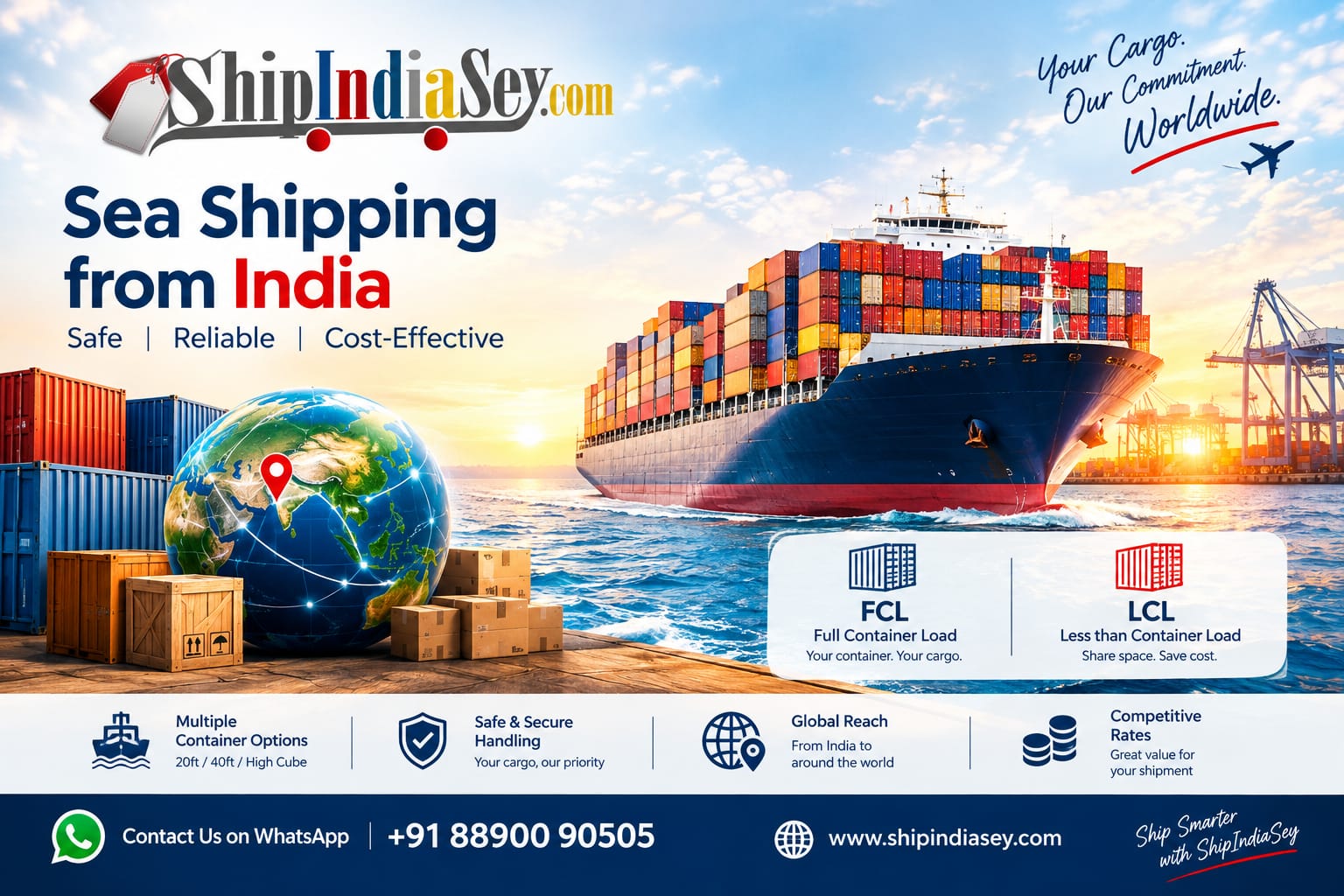
Need to ship bulk goods, commercial products, machinery, furniture or personal cargo from India to another country? ShipIndiaSey helps individuals, businesses, manufacturers, suppliers and international buyers explore sea freight solutions from India. Whether you need a full shipping container or want to share container space with other shipments, we can help you understand your options, coordinate shipping arrangements and explore suitable delivery services.
From cargo pickup and export documentation to customs clearance and final delivery, our goal is to make international sea shipping easier to understand and manage. Request a sea cargo quotation and tell us what you need to ship, where it is located and where it needs to go.
WhatsApp ShipIndiaSey: +91 88900 90505
Sea freight, also known as ocean freight or sea cargo shipping, transports goods internationally by ship. It is commonly used for large shipments, bulk orders, commercial cargo, industrial equipment, furniture, handicrafts, textiles and machinery. Sea shipping can cost less per unit than air freight for large shipments, although transit times are longer and handling, customs and destination charges may apply.
ShipIndiaSey helps customers explore sea freight from India and understand the shipping options available for their cargo and destination.
The right option depends on cargo volume, weight, goods type, destination, delivery deadline and total logistics cost.
FCL means booking a full shipping container for your cargo. The container is allocated to your shipment rather than shared with unrelated customers. FCL can suit exporters, manufacturers, wholesalers, commercial buyers and businesses shipping large quantities internationally.
| Container Type | Approx. Internal Volume | Approx. Maximum Payload |
|---|---|---|
| 20-foot Standard | 33 CBM | 28,000 kg |
| 40-foot Standard | 67–68 CBM | 28,000–29,000 kg |
| 40-foot High Cube | 76 CBM | 28,000–29,000 kg |
These are approximate industry specifications, not guaranteed usable capacity. Exact dimensions, payload, container condition, carrier specifications and route restrictions must be confirmed for your booking.
CBM stands for cubic metre, a measurement of cargo volume. For a rectangular box:
Length (m) × Width (m) × Height (m) = CBM
For dimensions in centimetres:
Length × Width × Height ÷ 1,000,000 = CBM
Add the volumes of all packages together and include pallets or other packaging in final packed dimensions.
FCL can be faster because it does not need to wait for a shared container to be filled and may avoid some consolidation and deconsolidation steps. Actual transit depends on vessel schedules, port congestion, customs, transshipment, inland transport and destination. FCL does not guarantee a delivery date.
LCL lets you ship smaller quantities by sharing container space with other customers. It may suit smaller commercial shipments, samples, furniture, selected personal cargo and orders that do not justify a full container.
Cargo is taken to a consolidation facility, measured and combined with compatible shipments. At destination, the shared container goes to a deconsolidation facility so shipments can be separated for customs processing, collection or delivery.
LCL freight is commonly calculated using chargeable volume in CBM or weight in metric tonnes, whichever is greater, subject to the carrier tariff and minimum charges. For example, 2 CBM weighing 500 kg may be charged on 2 revenue tonnes under a standard weight-or-measure tariff. Cargo measuring 1 CBM but weighing 1,300 kg may be charged by weight instead. Confirm the actual tariff, chargeable measure and minimum billing rules.
One CBM measures space, not a fixed cargo weight. A shipment of 1 CBM weighing around 150–300 kg is one example of relatively light or medium-density cargo, but actual cargo can be much lighter or heavier. Some LCL tariffs compare 1 CBM with 1,000 kg; other tariffs may differ.
These examples are illustrative. The actual quotation determines the applicable calculation.
LCL can take longer because cargo may wait for consolidation before departure and needs additional handling when shipments are separated at destination. Waiting time depends on cargo availability, consolidation schedules, route and facility. Customs inspections and port congestion can add delays.
Measure and pack carefully. Final packaged volume can exceed product volume because of cartons, protective materials, pallets and overhanging packaging.
Whole-CBM rounding is not universal. Some providers bill exact decimal CBM subject to a minimum. Ask ShipIndiaSey to confirm billing before booking. Never remove essential protective packaging just to reduce volume.
Choose FCL when cargo needs most or all of a container, dedicated space matters, or the total quoted cost compares favourably with LCL. Consider LCL for smaller shipments that do not need a full container. There is no universal CBM threshold at which FCL is always cheaper; compare complete port-to-port or door-to-door costs.
Sea shipments may pass through multiple handling points and spend an extended period in transit. Appropriate packing helps protect cargo against movement, stacking pressure, moisture exposure and handling damage.
Wooden crates or pallets are not required for every shipment. Requirements depend on cargo, handling, carrier and destination. Ask for packing costs and confirm whether materials, labour, palletisation, loading and inspection or certification charges are included. Do not ship prohibited or restricted goods without confirming permissions and documentation.
Your shipment may need to travel from a factory, warehouse, supplier, shop or residence to the port or consolidation facility. When requesting a quote, confirm:
Pickup charges depend on distance, cargo size and weight, vehicle type, loading requirements, location and route. These may be separate from ocean freight.
Cargo is shipped to the destination port, and the customer arranges applicable import customs clearance and collection. Depending on the booking, the customer may also coordinate terminal release, port handling, documentation, a customs broker and local transport.
Port collection can suit experienced importers with their own customs broker and local transport.
The service provider arranges the agreed import customs clearance, while the customer collects the released cargo from the port or designated terminal. This does not necessarily include inland delivery. Confirm whether customs brokerage, duties and taxes, terminal handling, inspections and cargo release fees are included. Duties and taxes may remain payable separately.
Ask about storage charges before cargo arrives: confirm free storage time, when charges begin, rates after free time and who pays if documents or payment are delayed. Confirm the exact collection location and whether a suitable vehicle is required.
Door-to-door aims to move cargo from the agreed origin address to the customer's final delivery address. Depending on the agreed service, it may include pickup, export handling, sea freight, destination handling, import customs clearance and final delivery. Door-to-door does not automatically mean every expense is included.
Customs duties, taxes, inspections, special unloading, storage, remote-area delivery and exceptional charges may be excluded. Confirm the written breakdown for pickup and packing, export documents, ocean freight, port handling, customs clearance, duties and taxes, final delivery, unloading, exclusions and free-time limits.
Export shipments from India require appropriate commercial and shipping documents. Requirements depend on the product, exporter, destination, transaction and regulations. Common documents may include commercial invoice, packing list, shipping instructions, bill of lading and applicable export declarations, licences or certificates. An Import Export Code (IEC) is generally required for businesses exporting goods from India, subject to applicable exemptions and specific rules. The exporter of record must be properly identified and documents must reflect the actual transaction. If you export in your own name, confirm IEC and documentation requirements with your customs broker or trade professional.
For eligible shipments, enquire about an export arrangement through our associated company, DamOverseas, subject to approval and product, transaction and destination requirements. The goods would be purchased or exported through an appropriate documented commercial structure, and DamOverseas would use its own applicable export documentation and IEC where legally appropriate.
The service charge discussed for this arrangement is 5% of the total goods value, subject to confirmation of scope and terms before proceeding. Shipping, packing, customs, duties, taxes, banking and other costs should be clarified separately. Exporter, invoice, ownership, payment and customs declarations must accurately reflect the transaction. Restricted or regulated products may need approvals or may not be accepted.
Sea freight is not always the cheapest or fastest choice. The best option depends on your priorities, cargo and destination.
A useful quotation starts with accurate cargo information and a clear understanding of who is responsible for each step.
ShipIndiaSey helps customers understand their options before committing to a shipment. Whether you have a few boxes, a commercial consignment, a bulk order or enough cargo for a full container, contact us to discuss available sea freight arrangements.
Service availability, documentation responsibilities and delivery arrangements depend on the route, product and agreed booking scope.
Send the following details on WhatsApp to help us understand your shipment:
The more accurate the information, the more useful the initial quotation. Final charges may change if actual measurements, packaging, weight, cargo details or destination requirements differ.
Planning to ship goods from India internationally? Whether you need a full container, LCL cargo shipping, export assistance or help arranging delivery, start with your cargo details.
WhatsApp ShipIndiaSey: +91 88900 90505
Share your cargo type, package count, dimensions, weight, origin, destination and preferred delivery method. Our team can review your requirements and help explore available arrangements.
Visit www.shipindiasey.com to learn more about our international shipping services.
ShipIndiaSey — Helping your cargo move from India to the world, with clearer options and better-informed shipping decisions.